Zoysia Sod for Tampa Bay Lawns: Is It Right for You?
Zoysia sod for Tampa Bay lawns is dense and drought-tolerant, but the right fit depends on your yard's sun, soil, and traffic. An honest look from the local crew that installs it.
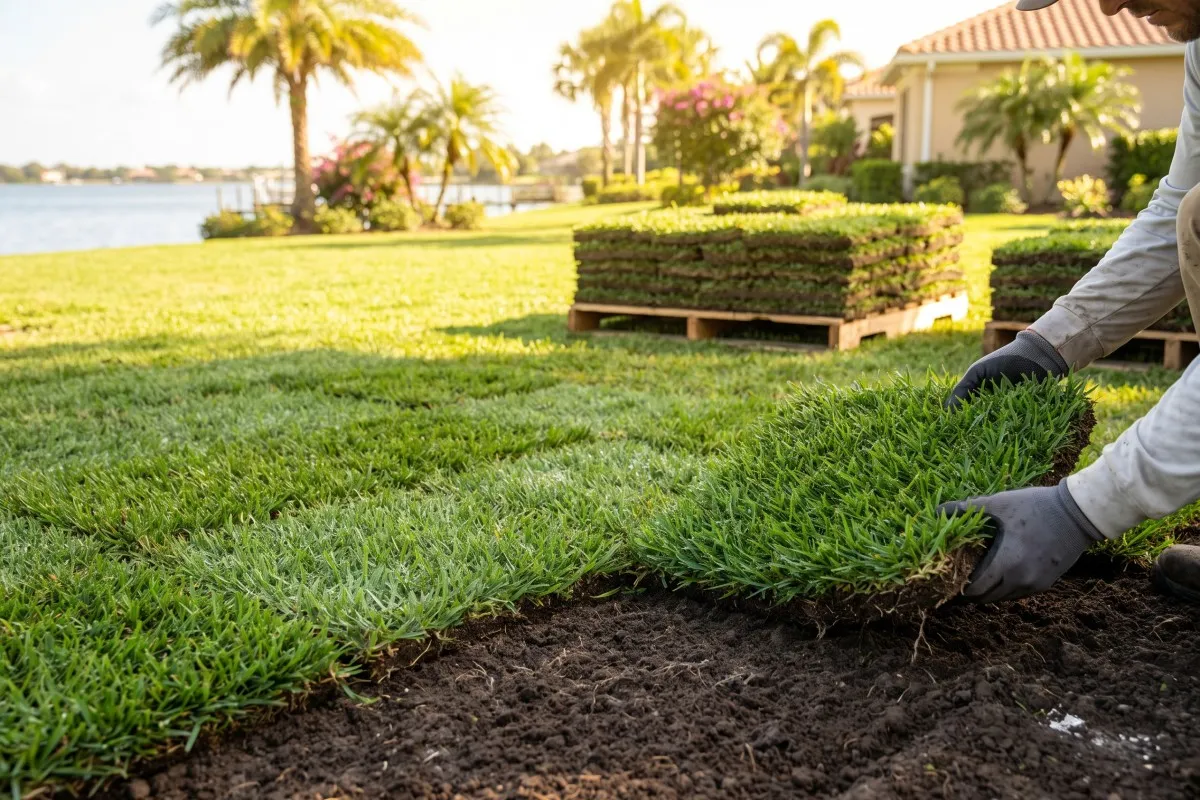
Zoysia sod for Tampa Bay lawns can be an excellent choice, but only in the right yard. We install a lot of grass across Hillsborough and Manatee County, and zoysia has earned its reputation with us for a dense, cushioned turf, good drought resilience, and strong wear tolerance. It is not, however, a drop-in upgrade for every lot. Zoysia asks for real sun, roots in slowly, and carries its own disease and pest pressures once it is down. Whether it fits comes down to conditions we check when we walk your property, not a claim on a catalog page. Here is an honest read, from the crew that lays it, on when zoysia is the right call for a Hillsborough or Manatee County yard, and when it is not.
Tampa Bay sits in USDA Hardiness Zones 9b–10a, and zoysia is a warm-season grass that grows most actively from spring through fall (UF/IFAS). Because our winters stay mild, we can put sod down in nearly every month of the year, so there is no single right season to install — only a set of site conditions to match the grass to.
What Zoysia Actually Does Well
Zoysia’s strengths are real, and they are the reason some of our customers ask us about it in the first place.
Dense turf that shrugs off traffic
It forms a dense, fine-to-medium turf that crowds out many weeds once mature, and in our experience it holds up to foot traffic better than St. Augustine — which is why we point active family yards that still get good sun toward it.
Drought resilience on sandy soil
Its drought tolerance comes from a deep, efficient root system. During dry stretches, zoysia tends to slow down and hold color longer than shallower-rooted grasses, and it can enter a semi-dormant state rather than declining outright (UF/IFAS). On the sandy Central Florida soil we work in every day — the kind that drains fast and holds little water — that root depth is a genuine advantage, and it is one reason zoysia lands on our shortlist of grasses well suited to Florida’s fast-draining sand.
Slower growth, less frequent mowing
Zoysia also earns its low-maintenance reputation on the mowing side. It grows slowly, so it needs cutting less often than fast growers. Fine-textured cultivars perform below 2 inches, while coarser types like Empire are mowed around 2 inches (UF/IFAS). One thing we always flag up front: holding a fine zoysia at its best low height often calls for a reel mower, and that is a cost we would rather you hear about from us than discover later.
Where Zoysia Struggles
The honest counterweight matters as much as the strengths — and we would rather talk a customer out of zoysia than put it in a yard that will fight it. Three limitations decide most of the zoysia projects we look at.
- It needs sun. Zoysia tolerates moderate shade better than Bermuda but noticeably worse than St. Augustine. Under the dense oak and palm canopy we see on so many Riverview, Valrico, and Brandon lots, zoysia thins where a shade-selected St. Augustine would hold.
- It establishes slowly. Zoysia’s slow growth is a maintenance perk once mature but a drawback at install: it can take a full growing season to knit fully, and it tends to build thatch over time (UF/IFAS). Bare seams and slow fill-in are normal early on — we tell every zoysia customer to expect it — not a defect.
- It is not disease-proof. Empire, the most common zoysia we install in Florida, performs well statewide but is susceptible to large patch (rhizoctonia), a fungal disease that thrives in our warm, wet conditions (UF/IFAS). Zoysia and Bermuda are also preferred hosts for the hunting billbug (UF/IFAS).
None of this rules zoysia out. It reframes the decision: zoysia rewards open, sunny, well-drained yards and punishes shaded, poorly irrigated ones. Our Tampa Bay lawn fungal disease guide covers how large patch shows up and how to manage the moisture that feeds it.
The Site-Visit Variables That Decide It
Picking a variety is a recommendation we earn on-site, not a shelf pick — because four measurable conditions do the deciding. This is exactly what our project managers map before we recommend zoysia for any specific yard.
Sun exposure comes first, because it eliminates options faster than anything else. Watch the area across a full day and count hours of unobstructed direct sun. Zoysia wants strong sun and will thin under meaningful canopy, so a shaded backyard usually points us elsewhere.
Soil and drainage come next. Zoysia’s deep roots pair well with Tampa Bay’s sandy ground, but the bigger question is what the sod itself was grown on. We install sand-bottom sod, grown on sandy soil rather than organic muck, so it integrates cleanly with native sand instead of layering a dense mat that traps water at the seam and slows rooting. Our guide to sand-bottom versus muck-bottom sod explains why the growing base changes how fast any variety takes hold.
Traffic load is where zoysia earns its keep. A dog run or a backyard soccer game that would thin St. Augustine is well within zoysia’s wear tolerance, provided the sun is there to support recovery.
Irrigation coverage is the quiet one. Zoysia’s drought resilience is real, but new sod of any variety needs consistent water to root, and dry, uneven coverage is one of the most common early-failure causes we run into. If parts of the yard are out of reach of the heads, that shows up first in a slow-establishing grass like zoysia.
Zoysia vs St. Augustine for Hillsborough County Yards
For most of the homeowners we talk to about zoysia grass in Hillsborough County, the real comparison is against St. Augustine, and it is a clean trade-off. Zoysia wins on wear tolerance, drought resilience, and mowing frequency; St. Augustine wins on shade tolerance, salt tolerance near the coast, and faster fill-in from sod.
So the rule of thumb we go by runs like this. Open, sunny, high-traffic lots with reliable irrigation are strong zoysia candidates. Shaded, tree-canopied lots — which describe a large share of the local residential yards we walk — usually point to a shade-selected St. Augustine like Palmetto or CitraBlue instead. For a full three-way breakdown, see our Tampa Bay sod variety comparison.
One note on the marketing you will run into: treat any pitch that a single variety is universally low-maintenance or trouble-free with skepticism. Every warm-season grass here has a weakness, and a matched recommendation beats a blanket claim — which is why we will not make one.
Installing Zoysia Sod for Tampa Bay Lawns: What to Expect
Zoysia sod can go down in nearly any month in Tampa Bay, and we cut it fresh right before we install it. Most residential projects we run finish in a single day. Expect slower knit-in than St. Augustine and plan first-month watering accordingly, tapering as roots take hold.
If your yard is open and sunny and you want a dense, durable, drought-resilient lawn, zoysia is worth a serious look. If it is shaded or your irrigation has gaps, we will tell you so rather than sell you a grass that will struggle. We are a local, family-owned company, and a matched recommendation is how we would want a lawn picked for our own homes. When you are ready, we can walk the property, map the sun, soil, traffic, and irrigation, and help you land on the variety that will actually thrive where you live. Get a free quote for a site-specific recommendation.
Sources: UF/IFAS Zoysiagrass for Florida Lawns, UF/IFAS Turfgrass Selection for Florida Lawns, UF/IFAS Large Patch in Florida Lawns.
Continue reading
What the New USDA Turfgrass Insurance Program Means for Florida Sod Buyers
The new USDA turfgrass insurance program in Florida covers sod growers, not your yard. Here is what it signals for sod buyers and how to protect your lawn.
Best Sod for Tampa Bay: St. Augustine vs Zoysia vs Bermuda
The best sod variety for Tampa Bay depends on your yard's sun, traffic, and soil. Here's how St. Augustine, Bermuda, and Zoysia compare.
St. Augustine Grass Varieties in Tampa Bay: Floratam vs. ProVista vs. Bitter Blue vs. CitraBlue
Compare the St. Augustine grass varieties Tampa Bay lawns rely on: Floratam, ProVista, Bitter Blue and CitraBlue, and how to pick the right one.