
Perennial Peanut: The Low-Maintenance Florida Landscape Groundcover for Sandy Tampa Bay Soil
Perennial peanut is a heat-hardy, nitrogen-fixing Florida landscape groundcover built for sandy Tampa Bay soil. Where it wins, and where sod still does.
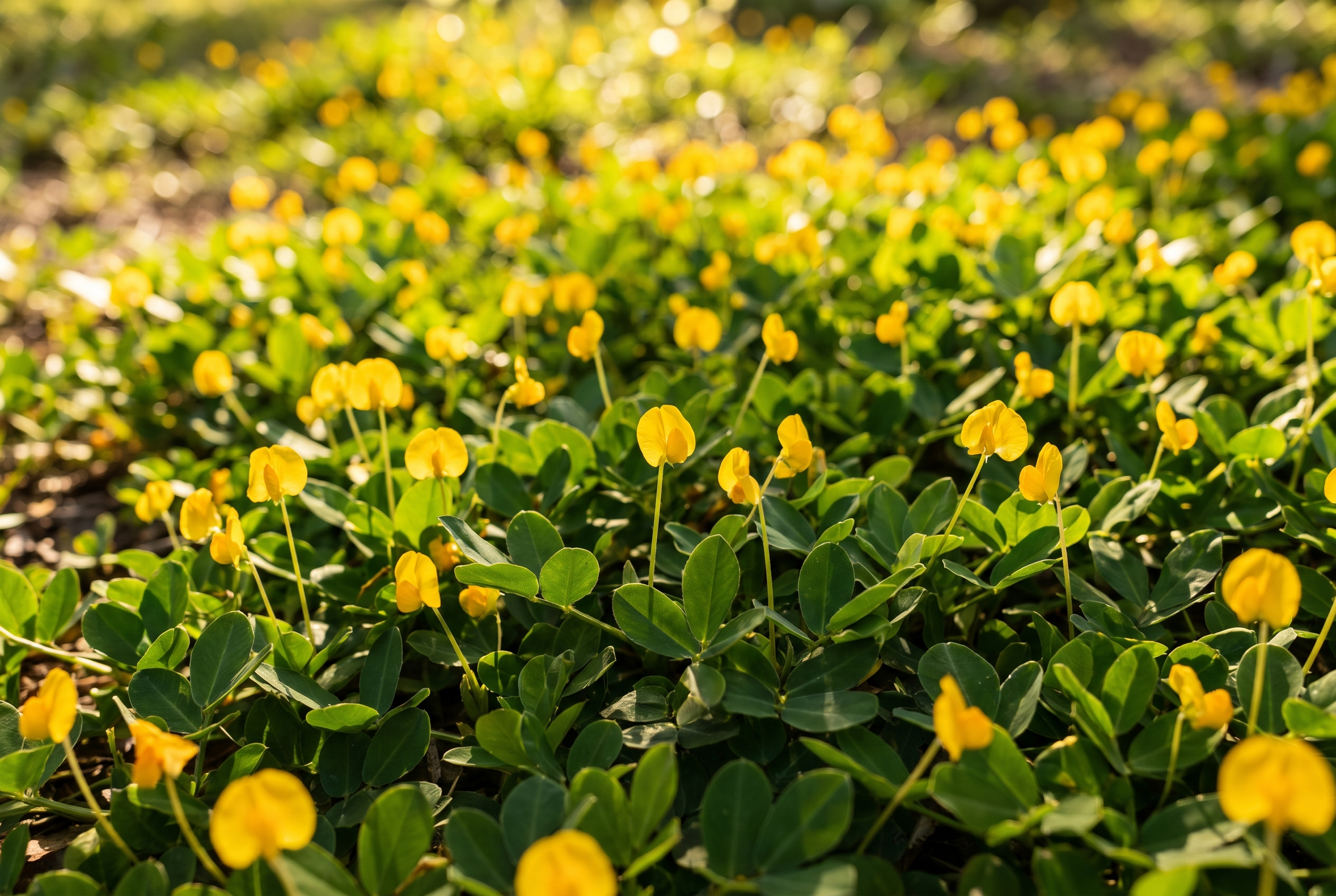
Yes, perennial peanut is a legitimate low-maintenance groundcover for a Florida landscape, and in the sandy soil we work across Tampa Bay it can outlast fussier alternatives. It feeds itself nitrogen, shrugs off drought, and covers ground with golden-yellow flowers through most of the warm season. But it is not a lawn. Knowing exactly where it belongs, and where fresh sod still does the job better, is the whole point of this guide.
The plant behind the name
Perennial peanut (Arachis glabrata) is a low-growing legume, a cousin of the peanut you eat, grown as an ornamental groundcover rather than for nuts. It spreads underground through rhizomes and forms a dense mat that stays roughly 9 to 12 inches tall. Two University of Florida releases, ‘Ecoturf’ and ‘Arblick’, were bred specifically for lawns and landscapes rather than for hay fields. Ecoturf stays low and can be mowed two or three times a year, though mowing is optional.
It is one of the few perennial tropical legumes adapted throughout Florida, cold hardy across USDA zones 8b through 11. That range covers every community we serve. Tampa Bay sits in USDA Plant Hardiness Zone 9b to 10a on the 2023 map, where warm-season plants grow nearly year-round. Perennial peanut thrives in that heat.
Why it suits sandy Tampa Bay soil
This is where the plant earns real attention. The ground under most yards we walk across Riverview and Brandon is loose, fast-draining sand, and that is exactly what perennial peanut wants. It is drought and salt tolerant, and it thrives in low-nutrient, sandy soils where thirstier plants sulk.
The headline trait is nitrogen fixation. As a legume, perennial peanut pulls nitrogen from the air and converts it into a form the plant can use, so it needs no applied nitrogen fertilizer. Keep a St. Augustine lawn fed and you are on a schedule. This plant feeds itself.
It also holds up against the pests that punish turf here. Perennial peanut shows high resistance to nematodes, insects and disease. That resistance is worth pausing on. Sandy Central Florida soil is ideal habitat for sting nematodes, the microscopic root feeders behind so many patches that never recover. We dig into that problem in our guide to turf nematodes in Florida lawns. A groundcover that ignores nematodes has genuine value in the corners where soil pressure keeps beating grass.
Where perennial peanut earns its place
Here is the installer’s read, from years of matching plants to sites. Perennial peanut shines where turf struggles and where few people walk:
- Sunny slopes and banks that are awkward to mow and prone to erosion. The rhizome mat knits the soil together and holds it.
- Borders and bed edges along driveways and walkways, where its golden-yellow flowers bloom through the warm months and read as finished rather than weedy.
- Full-sun problem patches that bake out St. Augustine, especially the low-nutrient spots where you would rather not run a fertilizer program at all.
It wants full sun to do its best. It tolerates only light to moderate foot traffic, not the wear of a sports lawn, and in busy paths growers set stepping stones to spare the plants. Picture it as a living groundcover for the edges and the trouble spots of a yard, not the middle.
Where we still reach for sod
We install sod for a living, and we will tell you plainly when it is the better call. Perennial peanut is not a play surface. If kids and dogs run the yard, if you want a lawn to walk barefoot across the day it goes in, or if the area sits in real shade, turf wins.
Two reasons stand out. First, patience. Perennial peanut is slow to establish, and plugs can take a full season or more to close in. Sod is the opposite. It is instant, complete cover the day it is laid, and we cut ours fresh, with most residential lawns finished in a single day.
Second, traffic and shade. St. Augustine and Zoysia take real footfall and handle Florida’s filtered light in ways perennial peanut cannot. For the honest tradeoffs against a no-grass option, we laid out the case in real sod vs. artificial turf.
The soil logic is the same one behind our choice of sand-bottom sod over muck-bottom. A plant grown on and matched to sandy ground roots faster and lasts longer. Perennial peanut and sand-bottom sod both respect that idea. They simply serve different parts of the yard.
Planting, patience and upkeep
Perennial peanut is usually established from rhizome sod, sod strips, plugs, or nursery containers. Solid sod gives the fastest cover and the cleanest fill. Plugs cost less and knit in over time, which suits a patient budget on a slope nobody uses this year.
Because it establishes slowly, growers commonly start perennial peanut in spring so the plant has a full warm season to spread. Once rooted, it holds in the ground here across all four seasons. This is one place where sod and groundcover part ways. Our sand-bottom sod can go down and root any time of year, with no window you have to wait for, while a fresh peanut planting rewards a head start and some patience.
Upkeep is the whole pitch. After the root system sets, irrigation is not required except during extended dry spells, and no nitrogen feeding is needed at all. Mowing is optional, a few passes a year if you want it crisp. Edging matters more than mowing, because those rhizomes will march into beds and lawn if you let them. That same vigor is a gift on a bank and a chore along a border.
The honest bottom line
Perennial peanut is a real, heat-hardy, low-maintenance groundcover for a Florida landscape, and it deserves a place in Tampa Bay yards. Put it on slopes, along sunny borders, and in the low-nutrient patches where grass keeps failing. It is not a replacement for a lawn you actually live on. The strongest yards we see use both, with perennial peanut where turf struggles and fresh sod where people and pets need a surface underfoot.
If you are weighing options for a problem area, our project managers can walk the site with you and say honestly which spots want groundcover and which want sod. Don’t settle for anything less than green.
Continue reading
Turf Nematodes in Florida Lawns: Diagnosis & Management
Turf nematodes in a Florida lawn are an invisible, misdiagnosed cause of brown patches that ignore water and fertilizer — how to confirm and fix it.
Sod Plugs vs. Sod Installation in Florida: Which Fix Is Right for Your Tampa Bay Lawn?
Sod plugs vs sod installation Florida: how we decide whether plugs can save your Tampa Bay lawn or a full re-sod is the only fix that will hold.
St. Augustine Grass Varieties in Tampa Bay: Floratam vs. ProVista vs. Bitter Blue vs. CitraBlue
Compare the St. Augustine grass varieties Tampa Bay lawns rely on: Floratam, ProVista, Bitter Blue and CitraBlue, and how to pick the right one.