Shade Tolerant Sod in Florida: What Survives Under Tampa Bay's Tree Canopy
Shade tolerant sod in Florida is a short list. Here is what actually holds under mature oaks and palms in Tampa Bay, and what quietly fails.
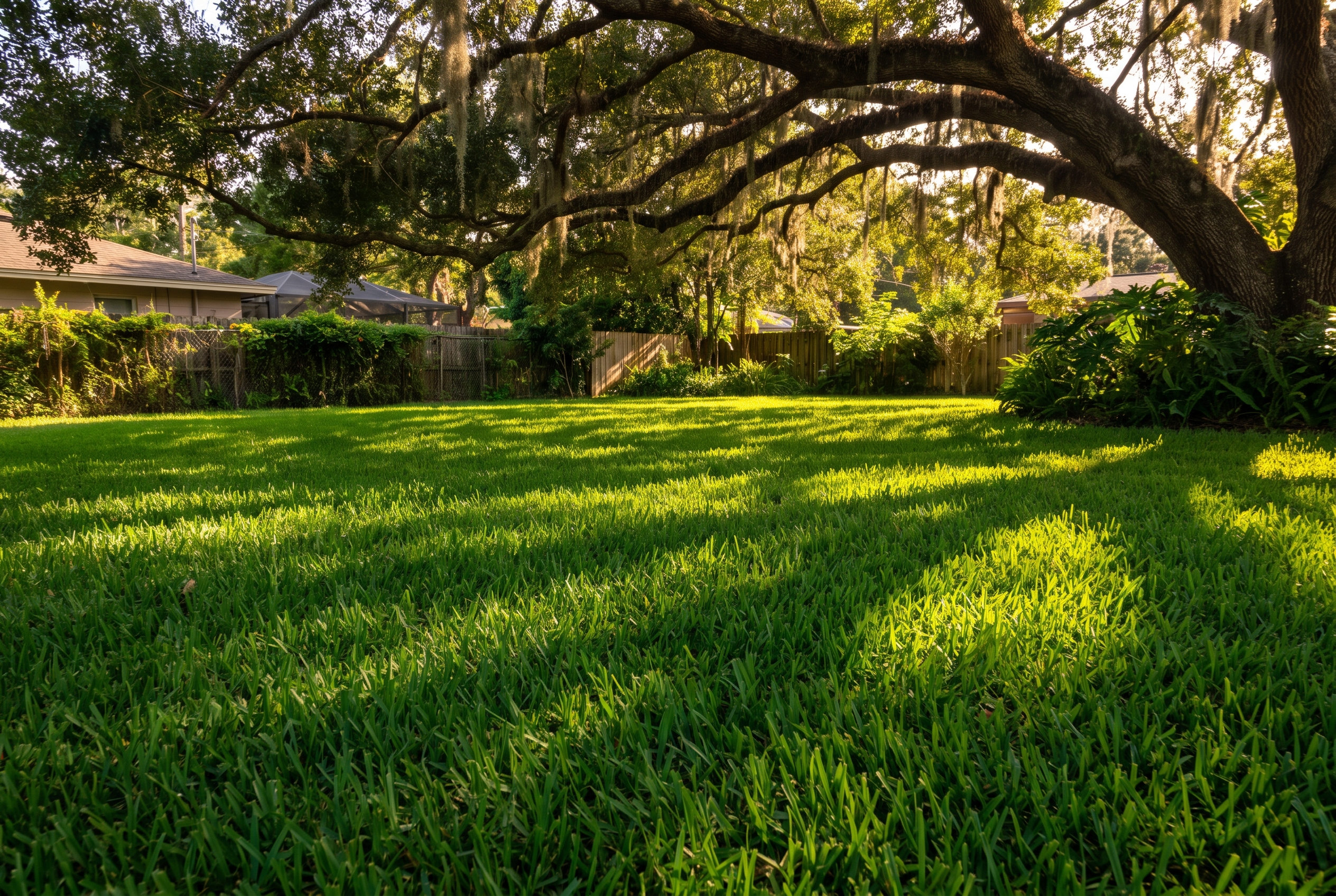
Shade tolerant sod in Florida comes down to a short list of St. Augustine cultivars, and even the best of them needs real sunlight to survive. That is the honest starting point we give every homeowner living under a canopy of live oaks. No sod thrives in dense, all-day shade. What we can do is match the right variety to the light your yard actually gets and tell you plainly where grass will not hold. That saves you from paying twice. This guide walks the shade question the way our crews walk it on the older, tree-heavy lots we sod around Lithia and Riverview.
Tampa Bay sits in USDA Hardiness Zones 9b–10a, and every grass we install is warm-season, growing most actively from spring through fall (UF/IFAS). Mild winters mean sod roots here in nearly every month of the year. Shade, not the calendar, is what decides whether a lawn under a tree makes it.
Shade Tolerant Sod in Florida Starts With an Honest Sun Count
Before we recommend a single square, we count the hours. Watch the shaded area across a full day and note how many hours of unobstructed, direct sun it gets. That number drives everything.
St. Augustinegrass is the most shade-tolerant of the warm-season grasses grown in Florida, but “tolerant” has limits. UF/IFAS is direct about it: turfgrass in shade generally needs several hours of sunlight or bright filtered light to persist, and sites with less should be planted in a shade-adapted groundcover instead (UF/IFAS, Growing Turfgrass in the Shade). Shade-selected cultivars can hold on roughly four to six hours of sun depending on the variety. Standard Floratam, the state’s most common cultivar, is not one of them. It has relatively poor shade tolerance and wants six to eight hours of direct sun, which is why it thins fast under any real canopy (UF/IFAS).
Filtered light counts too. Most St. Augustine actually performs well when up to about 30 percent of full sunlight is filtered through the canopy over the course of the day, per UF Extension, which is why the high, thin dapple thrown by a mature live oak can carry a lawn that a low wall of laurel oak would smother in a season. Same yard, same hours on paper, opposite outcome. A north-facing wall that never catches direct sun is its own case again, and we flag those on the walk.
The St. Augustine Cultivars That Actually Handle Shade
When a yard has moderate shade, we are almost always choosing among a handful of St. Augustine cultivars. Here is how they sort out on the tree-canopied lots we sod.
- CitraBlue is the current benchmark. Developed by UF/IFAS with shade as a breeding goal, it beat both Floratam and Palmetto in head-to-head university shade trials run over two years (Sod Solutions). It carries a blue-green color and a denser, lower habit, with better disease resistance than the Floratam most yards already have. For a moderately shaded yard where you want one variety to look good, this is where we start.
- Palmetto is the long-proven pick. It handles partial shade well and has years of local track record, though UF/IFAS notes it does well in “full sun or partial shade, but not in dense shade” (UF/IFAS). For a deep-shade backyard, Palmetto is a dependable default.
- Bitter Blue is an older cultivar with genuine shade tolerance. It reads more shade-tolerant than Floratam and keeps a deep blue-green look, which is why some homeowners still ask for it by name (Tampa Sod Farm). One honest caveat: it dislikes many broadleaf weed killers, so weed control takes a lighter hand.
- Seville is the dwarf, fine-textured option, among the most shade-tolerant St. Augustines and well suited to smaller shaded yards where a compact turf looks right.
We do not stock every one of these on every truck, and availability shifts through the season. What matters is that the shortlist for a shady Tampa Bay yard is St. Augustine. Bermuda needs full sun and thins under canopy. Zoysia takes more shade than Bermuda but still gives ground to a shade-matched St. Augustine where the light gets tight. We break down that full comparison in our sod variety guide for Tampa Bay, and the cultivar detail lives in why St. Augustine leads local lawns.
A Realistic Sod Shade Scale for Florida Yards
Most shade charts online give you a tidy gradient. Yards do not work that way. Here is the plain-spoken sod shade scale we use across Florida when we look at a canopy.
Six or more hours of direct or bright filtered sun. Almost any St. Augustine works, including budget Floratam. Full range of choices.
Four to six hours. Shade-selected cultivars only: CitraBlue, Palmetto, Bitter Blue, or Seville. This band is where most of our tree-shaded installs land, and where variety choice earns its keep.
Under four hours of usable light. This is the honest line. No St. Augustine cultivar reliably holds here, no matter how carefully you water or fertilize. UF/IFAS recommends a shade-adapted groundcover for these sites, such as Asiatic jasmine, mondograss, or liriope (UF/IFAS). We would rather tell you that on the front end than sell you sod that browns out under the oak by the second summer.
That last band is the one homeowners most want to argue with, and we understand why. A struggling patch under a big tree is frustrating. But watering a shade problem harder usually makes it worse, because constant moisture under a canopy is exactly what brown patch and gray leaf spot want.
When the Shade Is Too Deep: What We Tell Customers
Assessing shade is half the job. Saying “grass will not survive here” is the other half. A crew that lays sod into a dark corner without a word is not doing you a favor. It is booking a callback.
On a site walk we read how dense the canopy is and which way the shadow falls, then watch how both shift from morning to late afternoon. Sometimes the fix is not a different grass. Thinning or raising an oak’s lower limbs can turn a four-hour corner into a six-hour one, and a certified arborist can do that without harming a healthy tree. Where the light stays borderline, we lean toward the most shade-tolerant cultivar available and tell you what to expect from that zone before the first pallet comes off the truck.
Giving Shaded Sod Its Best Shot
Once we have matched grass to the light, a few habits stack the odds in your favor. Mow high. Shaded St. Augustine kept on the tall end of its range holds more leaf surface per blade, and every extra bit of surface is more light gathered from a canopy that is already rationing it. Go easy on nitrogen, since shaded turf grows slower and resents being pushed. Water in the morning, deeply and less often, so the ground under the branches dries through the day instead of sitting damp overnight. Most Tampa Bay yards we sod are a mixed-light job anyway, full sun out by the mailbox and deep shade against the back fence, and the shady zone is the one that sets your maintenance rhythm because it is the one that fails first.
That wet-season moisture is the real enemy under trees. Shaded, humid, poorly drained turf is where fungal disease starts, and our region hands it a long window to work. We cover the specific steps in our guide to protecting shady lawns through the rainy season. The base the sod was grown on matters here as well. We install sand-bottom sod grown on sandy soil, which drains cleaner and roots faster into Central Florida’s native sand than muck-grown turf, and that drainage advantage counts double in a shaded spot.
None of this turns four hours of sun into eight. It gives an honest shade situation its best chance, and that is the promise we can actually keep.
If you have a canopy you love and a lawn that keeps thinning beneath it, we would rather walk it with you than guess from a chart. A project manager can count the sun, read the shade, name the variety that fits, and tell you straight if part of your yard belongs in a bed instead. That conversation is free, and it is the same one we have on every shaded lot we sod.

Fresh-cut sod installation, replacement, and delivery in the Tampa Bay area.
Continue reading
Bitter Blue St. Augustine: The Underrated Shade Sod for Tampa Bay Yards
Bitter Blue St. Augustine in Tampa Bay is an underrated shade sod. Here is how we match it to a tree-heavy yard and install it to hold.
How to Choose a Sod Variety in Florida: Read Your Yard's Sun, Shade, Soil, and Traffic
How to choose a sod variety in Florida starts in your own yard. Our four-factor checklist: sun, shade, soil, and traffic, done before any quote.
St. Augustine vs Zoysia Sod in Tampa Bay: Which to Choose
St. Augustine vs Zoysia sod in Tampa Bay comes down to sun and how hard the lawn gets used. Here's the step-by-step framework our crew uses to pick the right one.