Salt-Tolerant Sod for Tampa Bay: Coastal Grass Options for Apollo Beach, Ruskin and Sun City Center
A ranked guide to salt tolerant sod for Tampa Bay: which coastal grasses hold up to salt air in Apollo Beach, Ruskin and Sun City Center.
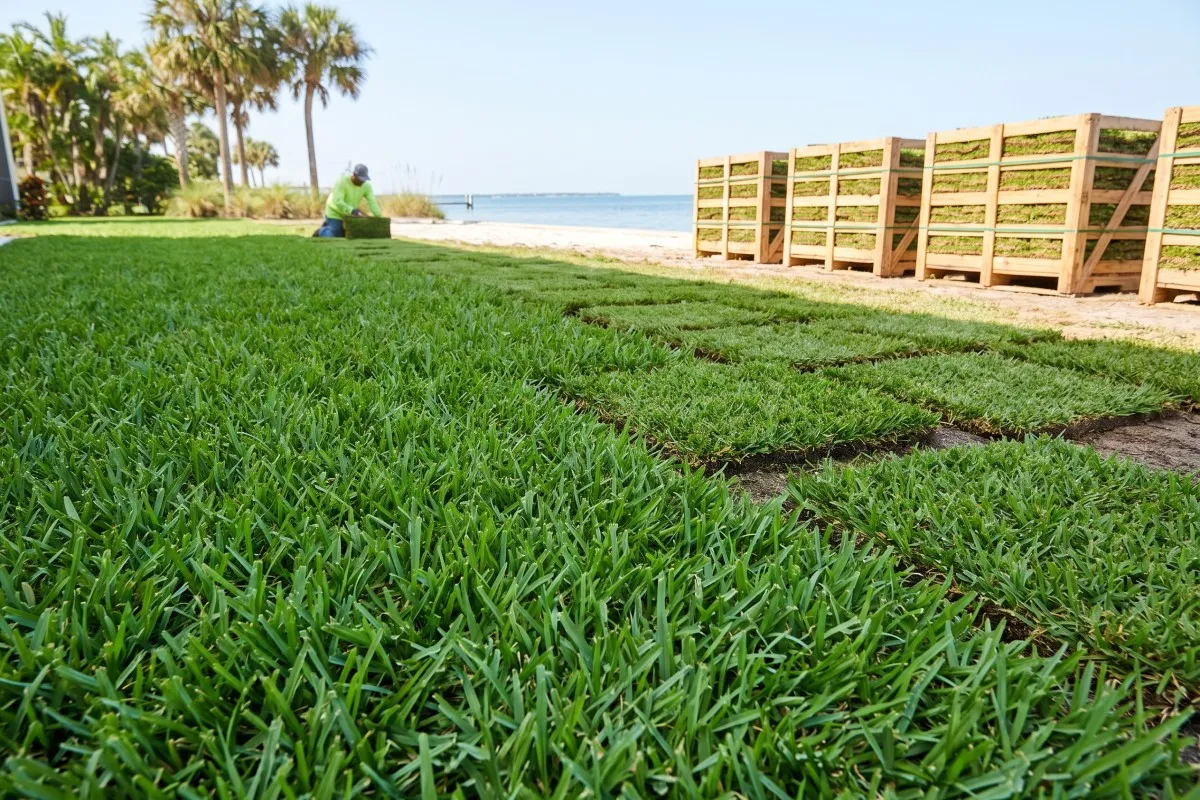
If the grass near your seawall keeps browning out, salt is the likely culprit, and the fix is salt tolerant sod chosen for Tampa Bay’s coast. The most salt-adapted option is seashore paspalum. It is not the only grass that lasts near the water, though, and it is not always the right one. Several varieties we install across Apollo Beach, Ruskin, and Sun City Center carry enough salt tolerance to hold where standard turf fails. This guide ranks them the way our project managers weigh them on a coastal site walk.
Tampa Bay sits in USDA Hardiness Zones 9b through 10a, and every grass here is warm-season, growing most actively from spring through fall (UF/IFAS). Our mild winters mean sod roots in during nearly any month. Site conditions decide the grass, not the calendar.
How Salt Reaches a Coastal Lawn
Most coastal grass failure traces back to sodium, and it arrives three ways. Salt spray drifts inland on the sea breeze and settles on the blades. Brackish groundwater rises through sandy soil at high tide. And irrigation drawn from a shallow well near the shore can turn salty on its own.
A single tidal surge can push saltwater across a yard for hours. Standard turf holds only moderate salt tolerance, so the roots will not knit into salted ground and the lawn thins where the salt sits. Homeowners often blame their watering. Sometimes that is fair. But when the same strip fails in the same place every year, close to open or brackish water, the soil chemistry is usually the real cause. If your trouble is really standing water rather than salt, correct grading often fixes it, and our guide on soil grading before a sod install covers that.
Salt-Tolerant Sod for Tampa Bay, Ranked by How Much Salt It Takes
Here is how the grasses we install sort out, from the most salt-adapted down to the ones we keep away from the water. Match this to how salty your site actually is, not to the toughest grass on the list.
- Seashore paspalum, the top salt tier. This is the most salt-tolerant turf we lay. It evolved on ocean dunes and can take saline or reclaimed irrigation water that would scorch other lawns (UF/IFAS). On a lot that floods on a king tide or catches heavy spray off the bay, it is often the only grass that survives. The trade-off is a narrower weed-control program and a lower mow. Our seashore paspalum guide covers the full picture.
- St. Augustine, the practical coastal workhorse. UF/IFAS places St. Augustine among the grasses that tolerate moderate to high salinity, and two cultivars stand out near the water. Floratam carries good salt tolerance and thrives in full sun, though it is weak in shade and cold. Seville is a finer, blue-green dwarf that handles salt well, with better shade and drought tolerance than Floratam (UF/IFAS). For most yards that see salt air but no direct flooding, this is where we land. See our Floratam guide for that cultivar in detail.
- Zoysia, good salt tolerance with density. UF/IFAS lists zoysia beside St. Augustine as a coastal-appropriate choice, with good tolerance to salt and traffic (UF/IFAS). Tolerance varies by cultivar. The finer types generally hold up better, and the result is a dense, cushiony lawn for an open coastal yard that still takes foot traffic.
- Bermuda, excellent salt tolerance but full sun only. Hybrid bermuda has excellent salt and wear tolerance and shrugs off drought (UF/IFAS). It recovers fast and takes heavy use, which is why it shows up on sports fields. The catch is sun. Bermuda needs six to eight hours of direct light and thins under shade, so it fits open waterfront lots, not tree-canopied ones.
- Bahia and centipede, leave these off a salty site. Both carry poor salt tolerance, below zoysia or bermuda (UF/IFAS). Bahia is a tough, low-input grass well inland, but near the water it thins and browns like any standard turf. Where salt is a real factor, neither belongs.
What Holds Up on the Coastal Jobs We Walk
The pattern rarely surprises us. Standard sod browns at the exposed edge first, usually the seawall side or a low corner that floods, then thins inward season after season. When a homeowner has already replaced the same strip two or three times, close to open or brackish water, the soil chemistry is almost always the cause and not their watering.
On genuinely salty ground, paspalum earns its keep. Everywhere else, a salt-tolerant St. Augustine like Floratam or Seville performs without the specialty upkeep. We lay sand-bottom sod on these lots, grown on sandy soil rather than muck, so it drains with the coast’s fast ground instead of trapping water at the seam (why the base matters). We cut it fresh right before installation. Most residential jobs finish in a single day.
How Salty Is Your Yard, Really?
Before committing a whole lawn to a specialty grass, we ask a plainer question. How much of the yard actually sees salt? Plenty of coastal lots have exactly one salted zone, a seawall strip or a flooding corner, while the rest does fine on ordinary St. Augustine. Converting the whole property is then money spent on a problem you do not have. Our project managers map sun, traffic, soil, and salt exposure before recommending anything, and the right answer is sometimes a blend rather than one grass. Our Tampa Bay sod variety comparison lays the main options side by side.
If you walk the same brown patch near the water every summer, that is worth a real conversation. We can measure where the salt actually reaches and tell you which grass will last where you live.
Sources: UF/IFAS Salt-Tolerant Lawngrasses, UF/IFAS Turfgrass Selection for Florida Lawns, UF/IFAS Seashore Paspalum for Florida Lawns, UF/IFAS St. Augustinegrass for Florida Lawns, UF/IFAS Zoysiagrass for Florida Lawns, UF/IFAS Bermudagrass for Florida Lawns.

Fresh-cut sod installation, replacement, and delivery in the Tampa Bay area.
Continue reading
Seashore Paspalum Sod: The Salt-Tolerant Grass for Coastal Tampa Bay
Seashore paspalum sod handles the salt air, brackish soil, and tidal flooding that thins standard St. Augustine across coastal Tampa Bay.
How to Choose a Sod Variety in Florida: Read Your Yard's Sun, Shade, Soil, and Traffic
How to choose a sod variety in Florida starts in your own yard. Our four-factor checklist: sun, shade, soil, and traffic, done before any quote.
St. Augustine vs Zoysia Sod in Tampa Bay: Which to Choose
St. Augustine vs Zoysia sod in Tampa Bay comes down to sun and how hard the lawn gets used. Here's the step-by-step framework our crew uses to pick the right one.